

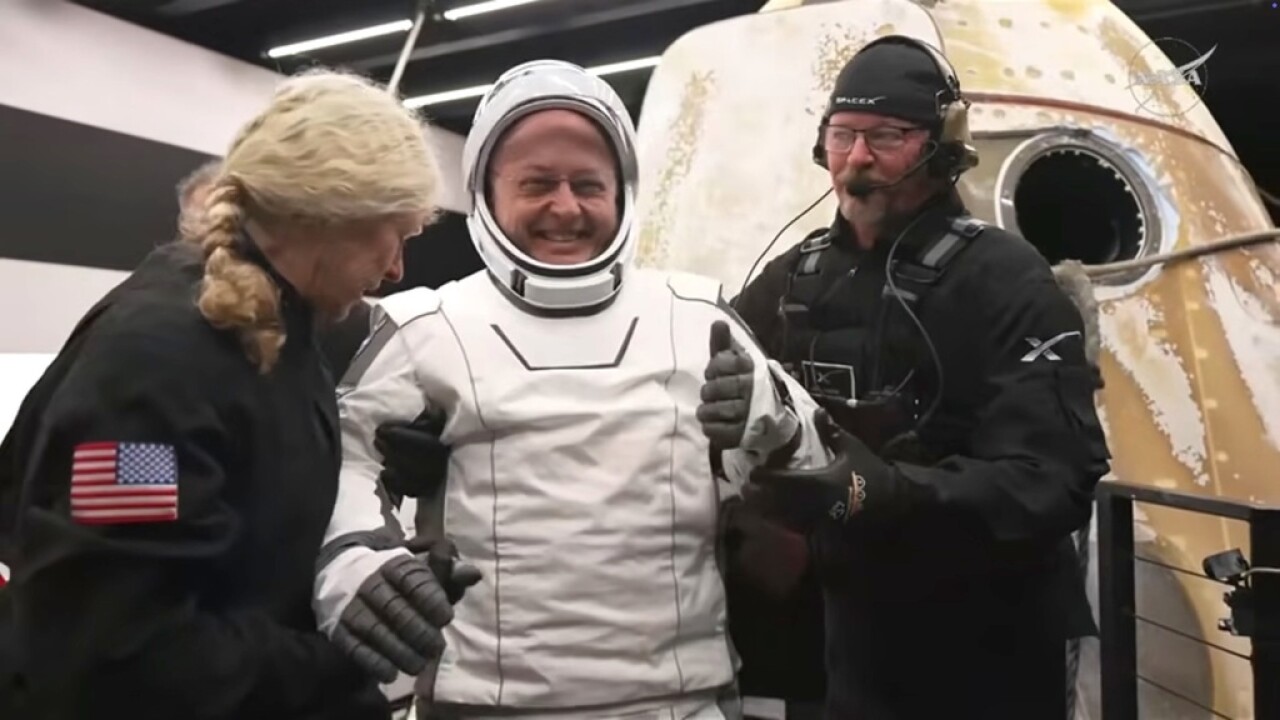


More than two months after a medical emergency aboard the International Space Station abruptly ended his crew’s mission, astronaut Michael Fincke still doesn’t know what caused his sudden illness.
Fincke said he experienced a brief period in which he was unable to speak, describing the episode as something that “came out of the blue.”
“We were getting ready for a spacewalk on Jan. 8, and the evening before we had just met with the doctors,” he said. “I was feeling super. Everyone was feeling super. And then I wasn’t.”
Four crew members returned to Earth in January after their five-month mission was cut short. NASA did not comment on the severity of the medical issue, citing privacy concerns.
RELATED STORY | NASA announces ambitious plans for a space station on the moon
Fincke said he was eating dinner when he suddenly could not talk.
“My crewmates saw I was in distress and immediately started taking care of me,” he said. “One of the Russian crewmates went to get the others, and it was all hands on deck within seconds.”
Within moments, flight doctors on the ground were looped in via video and guided the crew through initial diagnostic tests.
Unlike on Earth, there are no hospitals in space. NASA stocks medical supplies aboard the station, but they are minimal compared to what is available on the ground.
“I did my own echocardiogram—we have ultrasounds there—and it looked like I did not have a heart attack,” Fincke said. “We ran a few other tests to rule out some big issues. Eventually, we felt comfortable saying we didn’t know what was going on, but to rule out serious possibilities, we needed to come back to Earth.”
During their mission, the crew marked the 25th anniversary of continuous operations on the ISS and completed more than 140 experiments.
RELATED STORY |First medical evacuation from International Space Station brings crew safely home
Fincke believes his sudden illness may have been linked to prolonged exposure to microgravity.
He hopes the experience will help NASA develop strategies to keep astronauts safe during longer missions.
The incident comes as NASA prepares to send a crew on a lunar flyby, potentially as soon as this week. The Artemis program is designed to pave the way for a crewed mission to Mars — a journey that could keep astronauts away from Earth for years.
“It’s a really interesting time right now,” Fincke said. “As we prepare to spend more time on the moon and Mars, the space station is showing its value in low Earth orbit, helping us understand how humans and microgravity interact.”
