



Thousands of data centers are being built across the country this year to power the AI boom, but few people ever get a look inside.
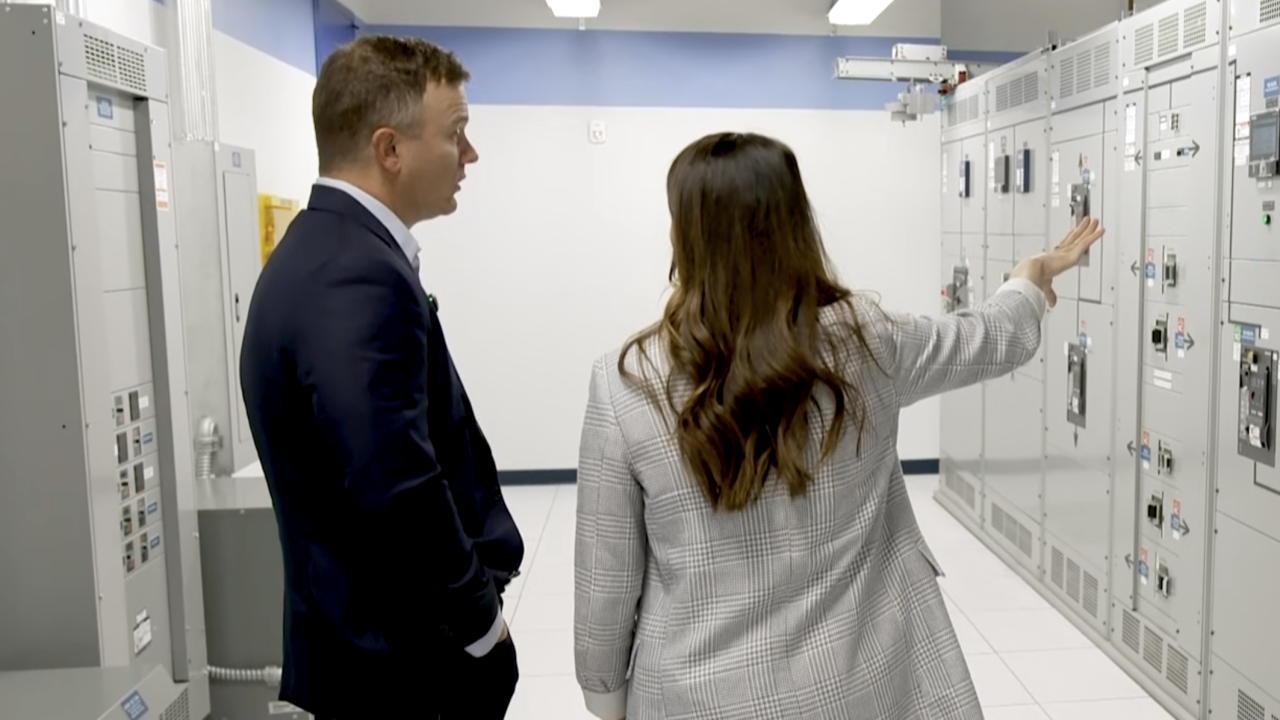
Scripps News got rare access inside Digital Realty's data center in Dallas, Texas — one of the largest data center platforms in the world — to see what's really going on behind the walls of these massive, yet somehow nondescript facilities.
Getting inside requires passing through a single-file turnstile, multiple card swipes and a biometric scan. Once inside, visitors must be careful around the surrounding cages that house servers — just touching one of them sets off a building-wide alarm.
That security and secrecy is essential to store, process and protect all of the data we use every day.
RELATED STORY | Amid rising power bills, Anthropic vows to cover costs tied to its data centers
Colin McLean, chief revenue officer at Digital Realty, said the company is at the center of a rapidly growing industry.
"It's a burgeoning requirement that more and the digital economies based on infrastructure that lives in data centers," McLean said. "At the same time, you see the emergence of AI. AI has become a core part of what's driving a lot of the utilization."
Digital Realty operates more than 300 properties across more than 50 cities globally.
Think of data centers like digital airports
Every time you stream a show, pay for groceries or ask an AI chatbot a question, your data is taking a trip. Data centers direct and process billions of data requests every second, all around the world.
"When people hear cloud, they think about some, some object in the ether," McLean said. "Cloud has to physically live somewhere and it lives in data centers."
The Dallas campus spans 1.3 million square feet. Inside, the space is divided into data halls filled with towers of servers. The more closely the servers can be stacked, the more productive the square footage.
Not all data centers look or work the same way. Some, like the one we visited, are like office buildings for data — multiple companies rent space and share the infrastructure. These are called colocation data centers. Big tech giants like Google often build and run their own private facilities, known as hyperscale data centers.
Keeping the machines cool
The loud hum inside a data center isn't the servers themselves — it's hundreds of fans powered by industrial-size air conditioners. Without them, the machines could overheat and fail, which could damage the backbone of the digital economy.
An enormous amount of electricity is needed to both power servers and supply those cooling systems. The center we visited runs on 100% renewable energy but also has backup diesel generators.
"We got 24 generators that support the six data halls," McLean said. "These kick in in the event there's a failure inside or there is a utility failure. Our clients really demand and expect resiliency as a tip top requirement."
A tripling of demand by 2030
There are currently more than 10,000 data centers globally, with more than half of them housed in the U.S. Forecasts predict demand for data centers could triple by 2030, increasing power usage to nearly 220 gigawatts — enough to power roughly 180 million homes.
RELATED STORY | Environmental groups demand national moratorium on new data centers over climate concerns
McLean said the industry is still in its early stages.
"We feel like AI is just the beginning stages," McLean said.
As this industry keeps expanding, questions about energy demand, community impact and sustainability issues are only getting louder. Our reporting will continue to explore how data centers are adapting with cutting-edge cooling technology — and how communities are organizing to prevent further construction.