

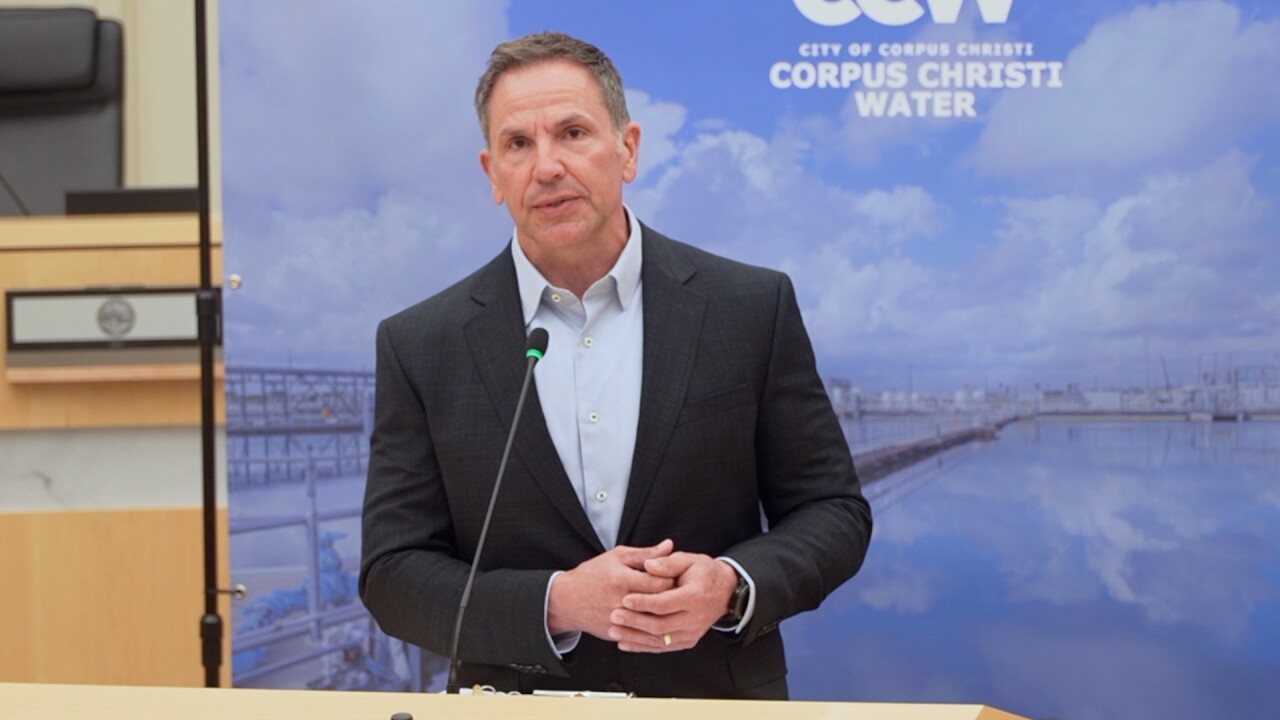


CORPUS CHRISTI, TX — At each week's city water briefing, a sign sits outside that reads, "This question period is reserved exclusively for media." This means residents impacted by the water situation cannot ask questions directly.
To find a way around that, I put out a post yesterday asking residents what their questions would be for City Manager Peter Zanoni. Dozens of responses came in.
"We appreciate KRIS 6 doing that we saw that ourselves," Zanoni said.
One hot-button issue is industry. Resident Sherry Butkay asked why industries that use more than half the water are not paying more than half the cost of fixing the situation.
"I know the answer is they are. They are paying their fair share. I recommended in one of our budget processes and City Council approved it, it was literally a doubling of the rates for large volume users. All customers pay per portion for the water they use, so if they use 50-60 percent of the water they're paying for 50-60 percent of the water they're paying 50-60 percent of all costs associated with that water," Zanoni said.
Resident Sean Dylan Merritt asked why surcharges and curtailment are being approved before a Level 1 water emergency exists.
"Customers want to plan and budget, If we do surcharges and price goes up a little for water, institutions like school districts, hospitals, commercial businesses like hotels and restaurants they need to forecast out how much I'm going to spend now on water. If I can't take my full allotment and I'm reduced what does that mean for my business? So I have to start thinking about that now so I have several months so that we're not springing it on them out of the blue one day," Zanoni said.
Resident Julie Winkler asked about water quality, specifically why city officials are saying arsenic is coming from the lakes when other municipalities drawing from the same lakes are not failing water quality tests.
"Well unfortunately they are failing. Water coming from our treated plant is still of high quality but if a community is drawing water exclusively from one of our sources in the west, Choke Canyon or Lake Corpus Christi, and they don't have the ability to blend it with any other water it will have elevated arsenic levels. That's why we're working with communities to help them even if they're not a customer of ours. Like the city of Robstown will have access to treated water from us," Zanoni said.
Another question came from Jessalyn Dixon who asked about the city's plan for rural Nueces County residents when their private wells run dry.
"For the residential wells their wells may be going dry because we're in a drought of record. "When it does rain that surface water drains into that 300-500 foot depth and those do replenish," Zanoni said.
He added that the city's hydrogeologist tells him the drought is to blame, not the city's drilling of wells.
"There are families and ranchers seeing a difference in their well. It's not necessarily because of what we're doing, it's more so because of the drought. As they use the water and there's no replenishment in the aquifer it can have an impact on the well."
This story air by a journalist and has been converted to this platform with the assistance of AI. Our editorial team verifies all reporting on all platforms for fairness and accuracy.
